Puglia in Five Days: Alberobello’s Trulli, Polignano’s Cliffs and the Baroque Lecce
Five days in the heel of Italy — the conical trulli houses, the cliff villages of the Adriatic, the white town of Ostuni, and the Baroque masterpiece of Lecce.
📍 Puglia, Italy
Puglia is the heel of Italy — the long flat region running south-east from the Apennines to the tip of the Italian boot, with the Adriatic Sea on one coast and the Ionian on the other. It is the slow, sun-soaked, agricultural part of southern Italy that, in the last 20 years, has gone from being almost unknown to international visitors to being one of the most-talked-about regions in the country. The reasons are obvious once you arrive: Alberobello, the small town of conical-roofed trulli houses (UNESCO World Heritage, looking like a fairytale village dropped in the middle of olive groves); Polignano a Mare, the white-washed cliff village built on a 20-metre limestone cliff over the Adriatic; Ostuni, “La Città Bianca” (the white city), a hilltop town of dazzling white-washed buildings visible from miles away; Lecce, the “Florence of the South,” a small city of extraordinarily ornate Baroque architecture in pale honey limestone; and a network of masserie (the historic fortified Puglian farmhouses, many of which have been converted into beautiful boutique hotels) scattered across the countryside in olive and almond groves.
Five days is the right length for a first trip. You will leave wanting to come back for two weeks.
The setup
Fly into Bari (north Puglia) or Brindisi (central Puglia). Hire a car at the airport — Puglia is dispersed and the small towns need wheels.
Stay in a masseria for the central nights — the converted-farmhouse hotels are the most distinctive accommodation in the region, with thick stone walls, vaulted ceilings, beautiful gardens, and almost always excellent restaurants. Cost: €150–500 a night, depending on the masseria and the season.
Day one: arrive, drive south, settle near Alberobello
Arrive in Bari. Drive south for about an hour to the Itria Valley — the central rolling-hill region of Puglia, between Alberobello, Locorotondo, and Cisternino. Check into a masseria or a small B&B. Sit on the terrace, drink a glass of Primitivo (the local red wine, the same grape as Californian Zinfandel), watch the olive groves around you.
Day two: Alberobello
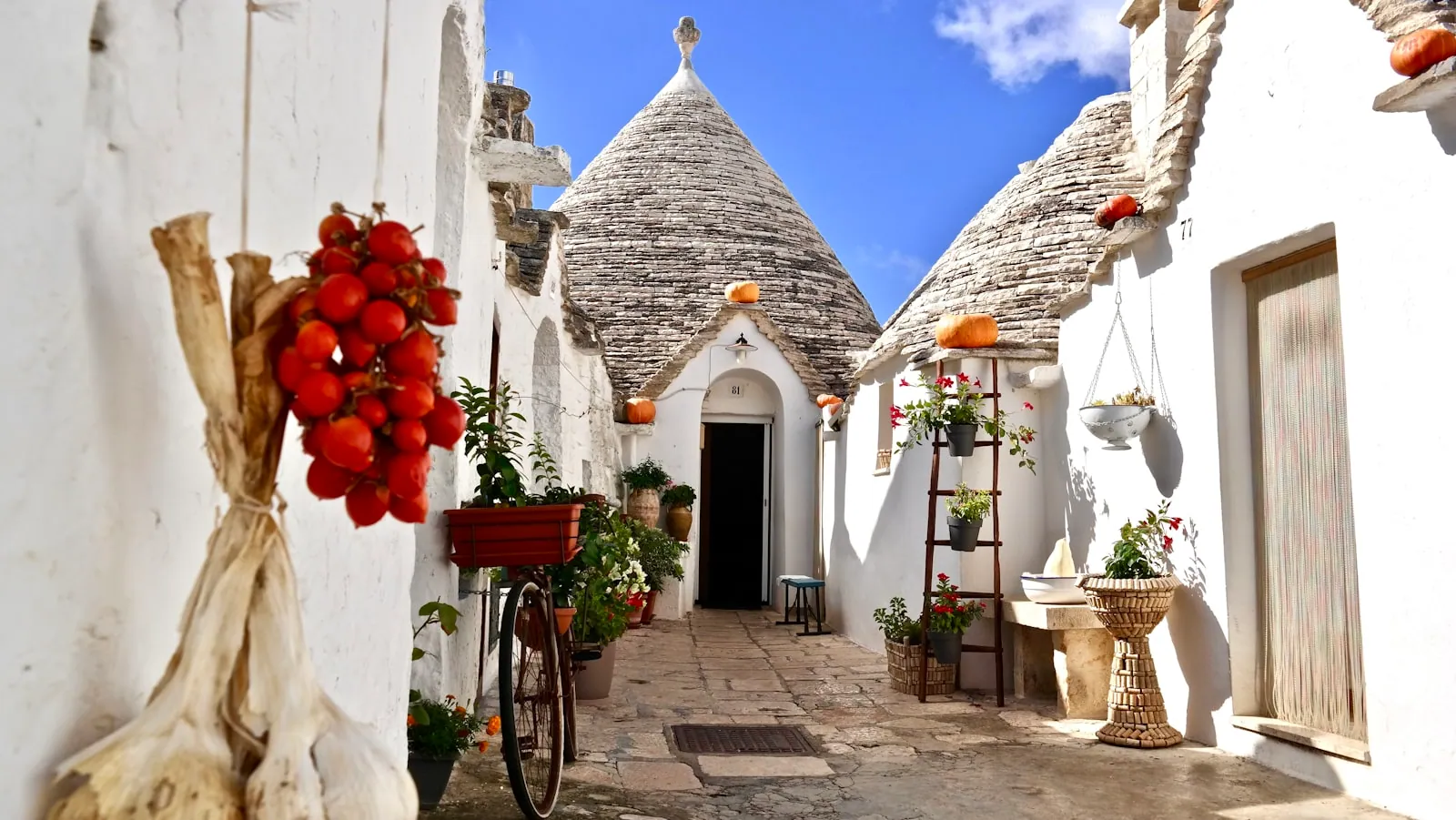
Drive to Alberobello in the morning. Alberobello is a small town (population about 11,000) of about 1,500 trulli — small white-washed dry-stone houses with conical limestone-tiled roofs, mostly built in the 16th and 17th centuries. The structure is unique to this part of Puglia, and its origin is a particularly Italian piece of tax-evasion history: the local feudal lord (the Counts of Conversano) wanted to avoid paying tax on his subjects’ houses to the Spanish viceroyalty, and the trick was that a building without mortar wasn’t legally a building — so the local farmers built their houses with carefully fitted dry stones that could be quickly dismantled when royal tax inspectors arrived, and rebuilt afterwards. The result, after centuries of refinement, is an entire town of these strange and beautiful conical houses.
The two main trulli quarters of Alberobello — Rione Monti (the larger, with about 1,000 trulli) and the smaller Aia Piccola — are both pedestrianised and walkable. Many of the trulli now house small shops, restaurants, and bars; some are still residential; a few are open as small museums. Walk the streets, climb up to the small viewpoints, photograph the conical roofs from every angle.
For lunch, eat at one of the small trulli restaurants. La Cantina, Trullo d’Oro, Casa Nova are all reliable. Order orecchiette (the famous “little ears” pasta of Puglia, hand-shaped) with cima di rapa (turnip greens) or with tomato and ricotta dura (the local dried ricotta).
In the afternoon, drive to nearby Locorotondo — a beautifully preserved hilltop town with a distinctive circular street pattern (the name means “round town”) and white-washed houses with steep gable roofs. A 90-minute walk through the small streets and a coffee in the central square. Or visit Cisternino, another small Itria Valley town famous for its butcher-shop tradition (you choose meat from the butcher’s counter, they grill it for you on the spot, and you eat it at small wooden tables in the back — the local Puglian fast-food tradition).
For dinner, eat at your masseria if it has a restaurant, or at one of the small Itria Valley trattorias.
Day three: Polignano a Mare and the Adriatic coast
Drive north to the Adriatic coast. Polignano a Mare is the famous cliff village built on a 20-metre limestone cliff above the sea, with the small Lama Monachile beach at the foot of the cliff (a tiny pebble cove between two rock walls, with the small medieval bridge of the village arching over it — possibly the most photographed beach in southern Italy). The old town is small, white-washed, packed against the cliff edge, with several viewpoints over the sea on the back streets.
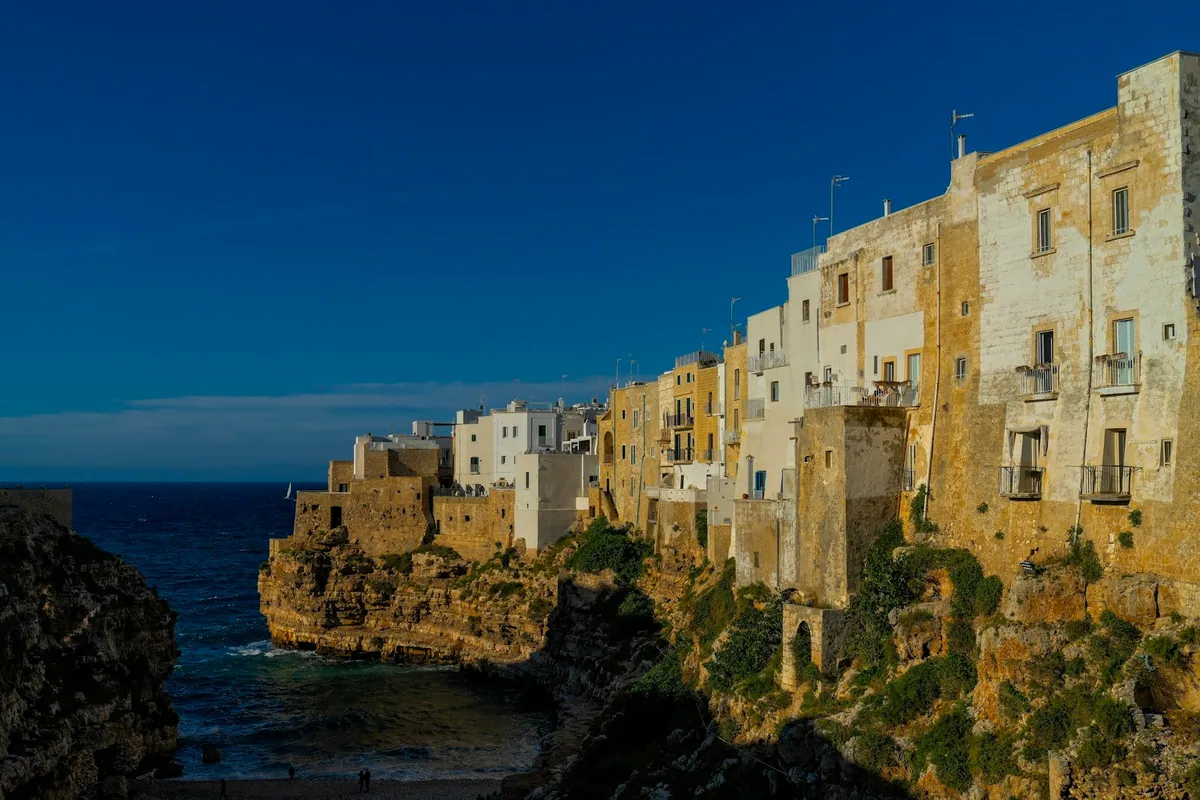
Walk the small streets. Visit the Grotta Palazzese — the famous restaurant built inside a sea cave at the foot of the cliff (a once-in-a-lifetime dinner for €200+ per person, but worth visiting just to see the cave). Climb down to the small beach for a swim. Eat lunch at one of the small restaurants on the cliff above. Reliable: Pescheria Due Mari (the seafood place), L’Osteria di Chichibio, or any of the smaller bistros on the back streets.
In the late afternoon, drive south along the coast to Monopoli (a small white-washed coastal town with a beautiful old harbour, less famous than Polignano but arguably more atmospheric for a longer evening) for a sunset and a long dinner. Reliable: Osteria Perricci.
Day four: Ostuni and Lecce
Drive south-east. Ostuni is the “White City” — a hilltop town of dazzling white-washed buildings visible from kilometres away across the surrounding olive groves. The old town, ringed by 14th-century walls, is a tight grid of white-washed alleys climbing up to the cathedral at the top — with the white walls in the bright Puglian sunlight creating an intense, almost blinding visual experience.
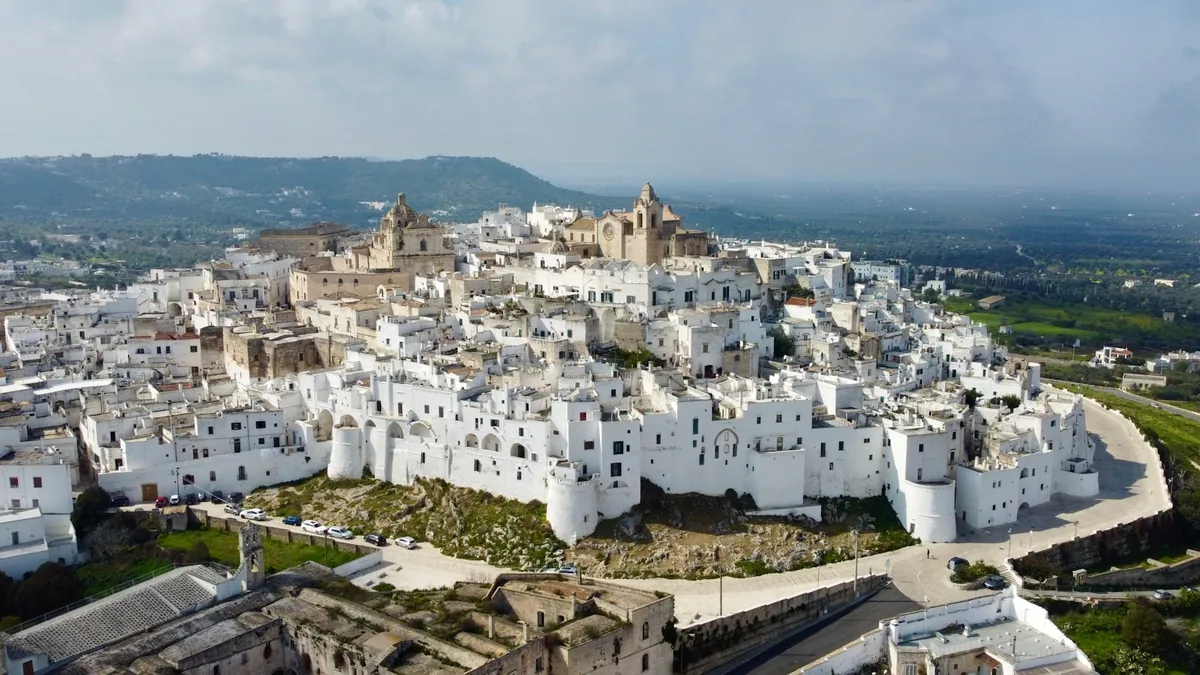
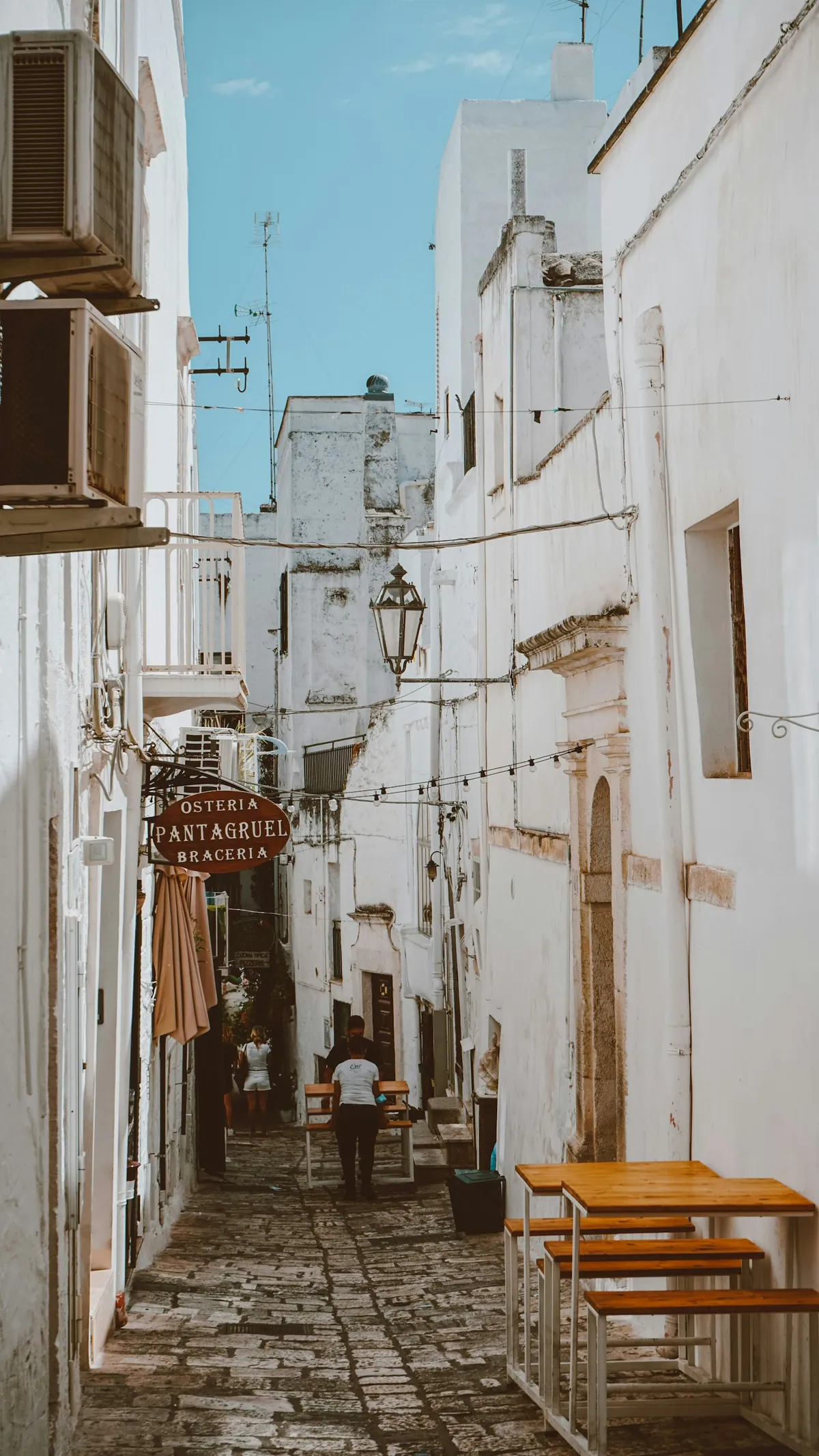
Walk the small streets up to the cathedral. Have an early lunch on one of the small terraces with views over the surrounding olive country. Then drive on to Lecce.
Lecce is a small city in the south of Puglia, the unofficial capital of the Salento (the southern peninsula), and one of the most architecturally striking small cities in Italy. The local soft pale honey limestone (Lecce stone) was extensively carved into ornate Baroque facades in the 17th and 18th centuries, and the result is a city centre of extraordinary architectural detail — every other building has carved cherubs, gargoyles, mythological figures, and elaborate plant-and-flower work covering its facade. The Basilica di Santa Croce is the headline — the most ornate Baroque facade in southern Italy, with carved figures covering every surface.
Walk the historic centre. Stop at the Roman Amphitheatre (only partially excavated; the rest is still under the modern Piazza Sant’Oronzo). Visit the cathedral (with its beautiful Piazza del Duomo, often described as one of the most theatrical small squares in Italy). Eat dinner at one of the Lecce restaurants — Le Zie (traditional Salentine cooking) or Alle Due Corti (the destination spot for orecchiette).
Stay overnight in Lecce or back in your masseria.
Day five: a slow last day — the Adriatic beaches or Otranto
Day five, depending on energy, either a beach day or a trip further south to Otranto.
For the beach, the white-sand beaches of the Salento coast are the headline. The Adriatic side — Torre dell’Orso, Sant’Andrea — has dramatic cliff coves. The Ionian side — Porto Cesareo, Punta Prosciutto, Pescoluse (the “Maldives of Italy”) — has shallow turquoise water and white sand beaches. Pick one and spend a day.
For Otranto, drive south to the small white-washed coastal town at the eastern tip of the Italian heel, with a beautiful 15th-century cathedral (the floor is covered in an extraordinary mosaic of biblical scenes, beautifully preserved), a small harbour, and dramatic cliffs to the south. A half-day visit.
End the trip with a final dinner at the masseria. Catch the morning flight from Brindisi.
How nice are Pugliesi?
Southern-warm. The Pugliesi have the same generous, food-focused, family-and-friends hospitality as the rest of southern Italy, with a slightly slower and more rural feel than Naples or Sicily. Within five days I had: a masseria owner walk me through her garden picking the herbs and the heirloom tomatoes she was going to cook for that night’s dinner; an Alberobello trulli shop owner give me a small free wooden trullo carving “for your kitchen, friend”; and a small trattoria owner in Locorotondo refuse to charge me for the digestivo at the end of dinner “because you ordered the local food, you respected the menu.” The Puglian welcome is real, generous, and unhurried.
If you go
• Stay in a masseria. The single best Puglian travel decision. • Hire a car. Public transport is essentially non-existent. • Visit between April and June, or September. July and August are very hot. • Eat the local pasta — orecchiette, taralli, focaccia barese, panzerotti, and the famous Puglian olive oil. • Drink the local wines — Primitivo and Negroamaro reds, Verdeca and Falanghina whites.
Puglia is the bit of southern Italy that has quietly become one of the most rewarding regions to visit. Five days here will give you the trulli, the cliff villages, the white town, and the Baroque. You leave wanting two weeks for the next visit. Most travellers come back.